Friday, December 5, 2008

The Crisis

[From 2008. Luckily (temporarily) the oil industry worked out how to cheaply extract difficult oil. However this makes environmental problems more difficult.]

The Crisis

Overview

The current financial crisis is not understood correctly, and the proposed solutions are thus incorrect.
The crisis is caused by the inability of the modern economic system to deal with a declining economy. The declining economy is an expected consequence of the Energy Crisis. The fact that oil production is increasingly incapable of keeping up with the demands of a growing economy is the first phase of the Energy Crisis. Later phases will be even worse unless we prepare now.
The Crisis is not about confidence, it is about real underlying problems that need to be addressed. The desire of people to take steps to prepare for the future is correct. The desire of governments to restart business as usual is wrong. People prepare by saving money. This is not the correct way for society as a whole to respond.
This document will mention many actions by society that might contribute to a solution. There is not enough leeway for us to go down many wrong paths. We need to make decisions based on hard-headed numerical calculation and vigorous open debate. We need to minimize decisions based on sectional interests and hidden agendas.
We need to accept that there will be a period of greater central control of the economy, and greater public ownership of economic assets. A Republican administration in the US has found that it needs to acquire an insurance company, so this should be obvious. It needs to be done in a more organized way. We need to plan for Long Crisis Socialism, not just do one ad hoc nationalization after another.
The Crisis will be marked by oscillations between periods of decline and deflation, and periods of economic revival and inflation. We need a better way of dealing with deflation. Current proposals to combat deflation by printing money and spending it randomly will work out badly, particularly if politicians get their hands on the money without oversite.


We are going to be short of expertise for many things we need to do. We are going to have to proceed bravely using intelligence and knowledge, as we do in wartime. The Internet makes knowledge accessible, and is a key tool.

Preamble

We face multiple crises: an energy crisis, a financial crisis and an environmental crisis. Let's just call it The Crisis. We will emerge from The Crisis significantly poorer. But the majority of people in the developed world, the middle class, will be happier, because they will have reclaimed their lives from the incomprehensible and incompetent economic powers that have imposed the current massive economic inequality on society.
According to the statistics we have enjoyed 60 years of nearly uninterrupted economic growth. Surely the middle class has benefited enormously from that? Let's compare the median American 2 child family between 1972 and 2006. In inflation adjusted terms the 2006 family spends significantly less on food, on clothes, on appliances. However they spend 70% more on housing. Does this mean they live in a big new McMansion? No only richer folk do that. Our median couple live in a fractionally bigger house, 6.1 rooms instead of 5.8, but it is 20 years older. The 2006 couple is less likely to have health insurance. The other new cost is education for pre-school and then for college. The significant fall in wealth is despite the fact that in 2006 it is much more likely that both parents work, even with very young children. The two jobs necessitates 2 cars. The final straw is this: in 1972 our median couple was saving 11% of their income. In 2006 it is -1%. Our 2006 family is gradually sinking into debt at the rate of 1% of income per year.
America is, in fact, poorer in many ways than it was in 1972. The reason is that 1972 was the peak of US domestic oil production. Since then an increasing amount of oil has come in from the global oil market, with wealth pouring out in return. But wait, a lot of the outgoing money isn't spent, and returns to America in loans. A giant financial industry grows up, skimming off enormous wealth while selling the white powder of debt to the increasingly impoverished American middle class. It was in fact a giant Ponzi scheme, dependent on new borrowing to prevent a credit collapse. Then the world as a whole hit peak oil in the 2005-2008 period. The resultant oil price spike pricked the debt Ponzi-like scheme. The economic collapse continues as this is written (Dec 2008), with no end in sight.
Society needs to make massive changes in basic infrastructure. It is abundantly clear that the current capitalist financial system is going to fail to support this work. We don't have the resources to get this work done while preserving the extravagant frivolous lifestyle of the rich. And indeed we can see that the rich have not been making the constructive contribution to our society that has been claimed and which might justify their privileges. How the middle class responds politically will determine how we come out of this crisis in 20 years time. We can go through a period of socialism and planning to get the job done, then transition back to an improved free market system that is ponzi-proof and doesn't require the current excesses of social inequality. Or we can just let the crisis play out with endless unplanned government interventions supporting the rich, and finally emerge with the massive social inequality that prevailed before the Industrial Revolution. The middle class is big, and waking it up is not easy, but that is the only route to change we can believe in.
Socialism is a dirty word in much of the West, but even Republican America is doing ad hoc nationalizations now. What we need is serious well-planned socialism. I commend Mike Moore's plan to socialize the American car industry for the duration of the crisis, but it needs to be done in a much wider planning context.
We'll start by trying to understand The Crisis before getting back to solutions and how to get there.

Money

The first thing to understand is money. Money is certainly funny stuff, and our understanding of it is rather coloured by the way it used to be a redeemable stand-in for some physical stuff (typically gold). As it currently operates money does two things well, and is pressed into service for some other things which it does less well, particularly in volatile times.
The things money does well are:
  1. Act as a medium of exchange to avoid the inconvenience of barter;
  2. Provide a measurement of the relative value of things at a point in time.
Money is not so good at providing a comparison of value across time. This is not just because of inflation and deflation, but because the relative values of things change, so that inflation and deflation are not well defined: they only make sense if you know exactly what basket of goods and services you are considering, and typically the basket that makes sense at one time is incorrect for a different time.
Money is used by people and organizations to move wealth into the future. We put dollars into a suitcase under the bed, and spend it at a later time. It seems as if the money in the suitcase is a magical store of value, but that is very misleading. What actually happens is this: when you put the money in the suitcase you take it out of circulation. This reduces the amount of money chasing the same amount of goods. This causes a small amount of deflation, making everybody else holding dollars minutely richer. Then when you get the money out of the suitcase and put it back into circulation, that money acquires its value by causing inflation and taking a small amount of value from all the other circulating money.
It is important to see that this process, which makes it possible to move wealth into the future through money, only works for entities embedded in a relatively stable wider environment. Society as a whole can't move wealth into the future through money. We'll come back to this point later. Real wealth isn't money, it is useful physical stuff, and knowledge and expertise. Some of it can be moved into the future, but most loses some or all of its value in the process.
There is a real economy out there with real goods and services and activities. One needs to think clearly about that, and not think too much about money. That's what we'll be trying to do in this document.

The Energy Crisis

The prosperity of the modern world has been built on cheap fossil energy, starting with coal for the Industrial Revolution. This fossil fuel is running out much more rapidly than estimates from official geological sources. Oil, and particularly cheap good quality oil, is evidently running out first. Even when the price was recently very high it was not possible to expand supply. Demand is now down because of the worldwide economic meltdown, but we are still using up this finite resource at a great rate. By the time demand recovers, the maximum available oil production rate will not be able to reach the plateau that we've seen from 2005 to mid 2008. It is almost certain that the peak of oil production is behind us and a long and bumpy decline lies ahead. The core job of governments over the next 20 years is to manage that decline and optimize the changeover to other sources of energy. More on that later.
This document will assume that we've passed peak oil, with peak natural gas and coal to follow within a decade or two. If you don't agree with this then what follows will describe a future rather than a current problem. That would be great. There would be time to prepare and possibly avoid any monumental economic catastrophe. But make no mistake: there has to be an end to exponentially rising consumption of finite resources (in this case fossil fuels), and there will be something like a bell shaped curve, with a peak followed by decline.

Oil use tracks the economy

The last 60 years have been the age of Oil, and the clearest indicator of that is how closely the world's economic production has tracked up and down with oil production. It makes no sense to ask which causes which. We saw how quite small reductions in oil production during previous oil shocks lead to matching economic declines. Most of the time we've seen the reverse, with a rising world economy demanding more oil, and until recently getting it.
The world's economic infrastructure, particularly transport, is tuned to oil. The economy will decline with oil production, though at times it won't be clear which is leading and which is following. As we switch away from oil, the economy will eventually decouple. We need to make sure that happens sooner rather than later. Some Peak Oil commentators think that this won't happen until there is something like a complete collapse of civilization. I don't believe that, but I do think the problem is very serious, and how bad things eventually get will be determined by the quality of our response now. If there was a break in the continuous thread of industrial civilization, then, with all the easily accessible resources used up, our descendants would have a much tougher time rebuilding an industrial civilization than our ancestors had in building it. Quite possibly there will be no second chance.

The Tsunami Effect

Those likening the current economic problems to a tsunami are more correct than they realize. The characteristic of a tsunami is that a sudden change in the ocean floor requires the ocean to make a matching change. But it can't make the change across the whole ocean instantly. Instead it makes a much larger change locally, and that change is communicated to the rest of the ocean in a series of waves. Suppose there is a sudden uplift in a part of the ocean floor. Then instead of lifting the whole ocean a minute amount, instead it lifts the water just above the uplift by a lot. The top of that water is then higher than the surrounding ocean and collapses outwards as a spreading wave. It collapses so fast that it overshoots downwards creating a local trough at the scene of the uplift. This then follows the spreading wave with a following spreading trough. And so on, so that we get the series of peaks and troughs that characterize the tsunami.
Something similar happened during the recent rise in the oil price. The underlying dislocation was the sudden appearance of an unbridgeable gap between the demand for oil at the prevailing price and the available supply at that price, and indeed supply was unable to rise at any price. There was a need to reduce demand to match supply. But it was impossible to reduce demand in a uniform way across the whole economy, since so much activity was predetermined by existing contracts and unavoidable use. So the bits of the oil demand that were able to reduce needed to be hit extra hard. The price had to go up enough to stop vacation and other optional driving across the world, and other easily modified behaviour. To do this the oil price overshot upwards by a lot. At the prices that were reached, many companies were the living dead, continuing only on momentum and hope and existing contracts.

The effects of the high price spread out like a wave, touching enterprises that aren't obviously much affected by the oil price. At the time of writing (December 2008) the economy is in free-fall. It has already dropped enough so that there is no shortage of oil, but it has much further down to go before it rebounds. When it does recover it will once again rise enough to hit declining oil production, the oil price will again soar, and a new episode of economic collapse will start. These are the waves of the Peak Oil Tsunami.
The future promises to actually be messier than the picture above suggests. Jeremy Grantham, chairman at Grantham Mayo Van Otterloo, an institutional money manager, said recently: "The global economy gives a good impression of having run at top speed into a brick wall". It is doubtful if we will get up that head of steam again. So the next time we will run into peak oil at a slower speed, with some parts of the world economy going well, and others less well. The price break out will be less dramatic and the crash less catastrophic. Maybe we'll ride the wave down the slope for a while instead of wiping out.

The Financial Crisis

Many think that the economic meltdown is just a result of problems in the financial system. It is certainly hard to disentangle these issues, but we'll try.

Recycling Money

In a barter economy, if you wanted to save for the future then you'd acquire durable stuff that would be useful later or exchangeable later. In a money society we like to save money. But money is funny stuff. If someone saves money then someone else has to go in to debt, to balance it out. Maybe you think they could just put it in a suitcase under the bed, but that would cause deflation and the central bank would end up creating money to lend to balance it out, aiming, as they do, for 2-3 percent inflation.
Unfortunately the world is cursed with some very determined savers. This includes the Chinese government and, most relevantly to us, some of the major oil producers. Hasn't it been a cosy deal. They send us oil and we send them bits of paper: dollar bills, bonds, equities. Much of this paper is turning out to be worthless. A huge financial industry grew up to recycle oil money back into the Western economies as loans. Hundreds of millions of dollars, or more, was siphoned off as our enthusiastic savers were connected to ever more dubious borrowers. “You mean I can live in this house for nearly nothing for 2 years, then walk away when you put the interest rate up?”; “Yep”. Then the lenders borrowed more money using those mortgages as collateral. Wow.
Still, no real wealth is destroyed by this chicanery. A lot of wealth has ended up in the wrong hands. The fact that banks and other financial institutions (and even countries) are insolvent is a real problem, but can be fixed, as we are seeing.
The real problem is that we have a declining economy and our economic system is not designed to handle that correctly. The oil price overshoot was always going to lead to an economic (and oil price) crash. But the management of the crash is incorrect. In particular allowing deflation is disastrous.

Deflation

The prices of houses and other fixed assets are declining. The prices of commodities are falling. This is deflation. It hasn't made its way to the supermarket shelves yet, so official CPI figures are still registering inflation. That's a good reason why governments need to change their way of identifying inflation/deflation so that they get on to the problem sooner.
The combination of economic decline with deflation is disastrous for many reasons. With total output declining, wages need to go down in real terms. Deflation means that wages are rising in real terms, and this can be very hard to renegotiate. The result is rapidly rising unemployment and companies going broke. Another problem is that companies are unwilling to sell assets preferring to leave them on the balance sheet at an inflated price, thus concealing the loss.
When we have a forced economic decline (and we need to get used to that) then we would like to have that run smoothly, with everyone getting poorer together. Deflation prevents that, causing the economy to seize up. Deflation is actually easy to fix, but the important thing is to do it in a way that addresses the underlying problems rather than the symptoms.

It is crucial that independent central banks, not politicians, address deflation, just as they have the job of preventing inflation. The solution to deflation is to print money and spend it. However it should be done in ways that (a) are reasonably fair and automatic; and (b) is to a large extent reversible when inflation reappears. It is also sensible for the government to requisition some of the printed money to spend addressing the underlying structural problems which lead to the economic decline.

Printing money is a tax. It is used by all governments in war time because it is so easy to collect. It is a tax on people holding money and on lenders. Because it is a tax, the central banks should provide the printed money to government for spending when there is appropriate tax legislation. Other than that it should be constrained to spend the money in an automatic way that is reversible. In America the Fed buys up outstanding government bonds. Australia doesn't have any such, and I think even America may not be able to buy enough. Also pumping money into the bond market is a very indirect way of getting it into the general economy. I think the questions of how to reversibly spend the money needs to be considered more. My instinct tells me that the right approach is for the central bank to buy durable stuff that it can expect to sell when the economy picks up. Why? Because this is what an individual in a pre-money society would do to prepare for the future.

In our current crisis Governments need to spend some of the printed money on infrastructure to address the underlying problems, but this will turn into a feeding frenzy of bad decisions if governments are allowed to spend the printed money without the consent and oversite of the legislature.

Capital Destruction

We've seen how reaching Peak Oil requires some process to destroy demand. More important than demand destruction is capital destruction. Here I am referring to real capital: useful physical assets, knowledge and expertise.

When we move to a new technology we destroy the capital associated with previous technologies. A recent example is the move to mobile phones. Suddenly all those pay phones weren't making any money. And it wasn't just the pay phone booths that had lost value: behind that was a whole lot of back office equipment and human expertise. Of course we absorbed that particular capital loss with no widespread pain. Switching from an oil based infrastructure will be extremely painful, even if the replacement is just as good. And it won't be.

The Great Depression of the 30s has been portrayed as being about nothing substantial: just economic mismanagement by Government and Central Banks. However looking back we see that it was a time of enormous change in the underlying infrastructure of the Western world. Energy moved towards electricity, oil and natural gas. Transport moved from horses to motorized vehicles. Communication moved to the telephone. There was massive capital destruction, and the need to build new and different capital. Having said that we can see that things would have worked better if governments had not allowed deflation and perhaps they could have done more to help get the new infrastructure up and usable.

In our current crisis, the capital destruction caused by moving transport away from oil is not just the obvious: vehicles, service stations, mechanic expertise, airports, ... . It also includes a lot of things built on the assumption of cheap transport, particularly the Western world's sprawling suburbs. When we subsequently move away from fossil fuel for electricity generation, that will also destroy the value of a lot of energy infrastructure.

The Underlying Problem

Getting the financial issues sorted out will reduce the pain and duration of the transition. Addressing the underlying energy problem is more important.

The initial problem is the decline in amount and quality of oil produced. Liquid energy has been particularly important for transport. We need to transition as smoothly as possible to alternatives. Boats and trains can transport for much less energy than road vehicles. Train lines can be electrified. Larger vehicles and boats can be run on compressed or liquefied natural gas. Cars can run on batteries or hybrid engines. Large ships could return to coal or even move to nuclear.

This is a huge change in infrastructure. Government will have to lead. Good decisions need to be taken about what to do and in what order.

Following uncomfortably soon we will see the worldwide peak and then decline of all fossil fuels. This is hard to believe in Australia where we have a lot of coal and gas, however there is no doubt that we will sell this, at least to our traditional friends, in an increasingly dangerous world. So the world, including Australia, needs to prepare for a post carbon economy. Of course this is pleasing for Australia which is predicted to be badly affected by climate change. Our chances of co-operation on reducing use of fossil fuels was never good, but it will turn out that the world has no choice.

The bad news is that all our non-carbon options, nuclear and various sorts of renewable, have significant up front capital costs before they then deliver energy with low marginal cost. The exception is biofuel which doesn't seem to deliver net energy at all, and will not be considered here.

As with transport, the government is going to have to take the lead in a huge capital investment during very difficult economic times. There is no room for spin, pork or emotional consideration in determining where to put that effort.

Energy for everything

It seems as if there are many inputs to our modern life, but all of them can be replaced with enough energy. If you want fresh water then energy can desalinate sea water and energy can transport the water.

If we look at any physical thing shaped by human intention or any human activity, then we can see that it was constructed using existing infrastructure plus energy. If we look at that infrastructure we can see that it, in turn, was constructed with previous infrastructure and energy. This can conceivably be traced backwards to when there was no infrastructure shaped by man at all. Energy is everything.

There is one other essential ingredient: Suitably educated humans to utilize the infrastructure.

Energy and Jobs

Energy and appropriately educated humans utilize existing infrastructure to generate directly useful stuff plus new infrastructure:
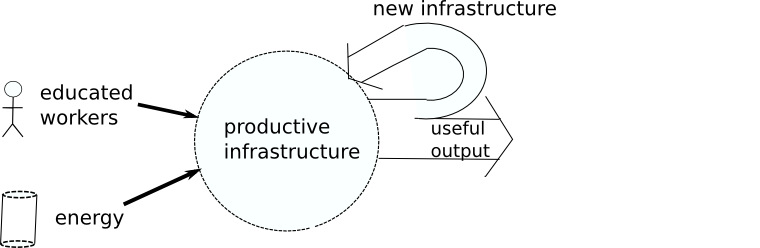

Note that our productive infrastructure is effectively decreasing because it is tuned to an energy mix which is changing. So total output is going to be reduced till that is fixed. To fix it we need to devote a larger proportion of output to building new infrastructure. So that is going to reduce the amount of useful output even more. And then our productive infrastructure is not optimized for its new job of building this new infrastructure, which reduces its effective size still more.

With the Industrial Revolution, we learned to utilize an easily expandable supply of cheap energy. This leads to ever more sophisticated infrastructure, and a huge demand for educated workers to drive that infrastructure. The relative shortage of workers drove up wages and drove the price of energy down. In the following diagram the icons are set so that a typical activity requires an equal number of people (workers) and barrels (energy):
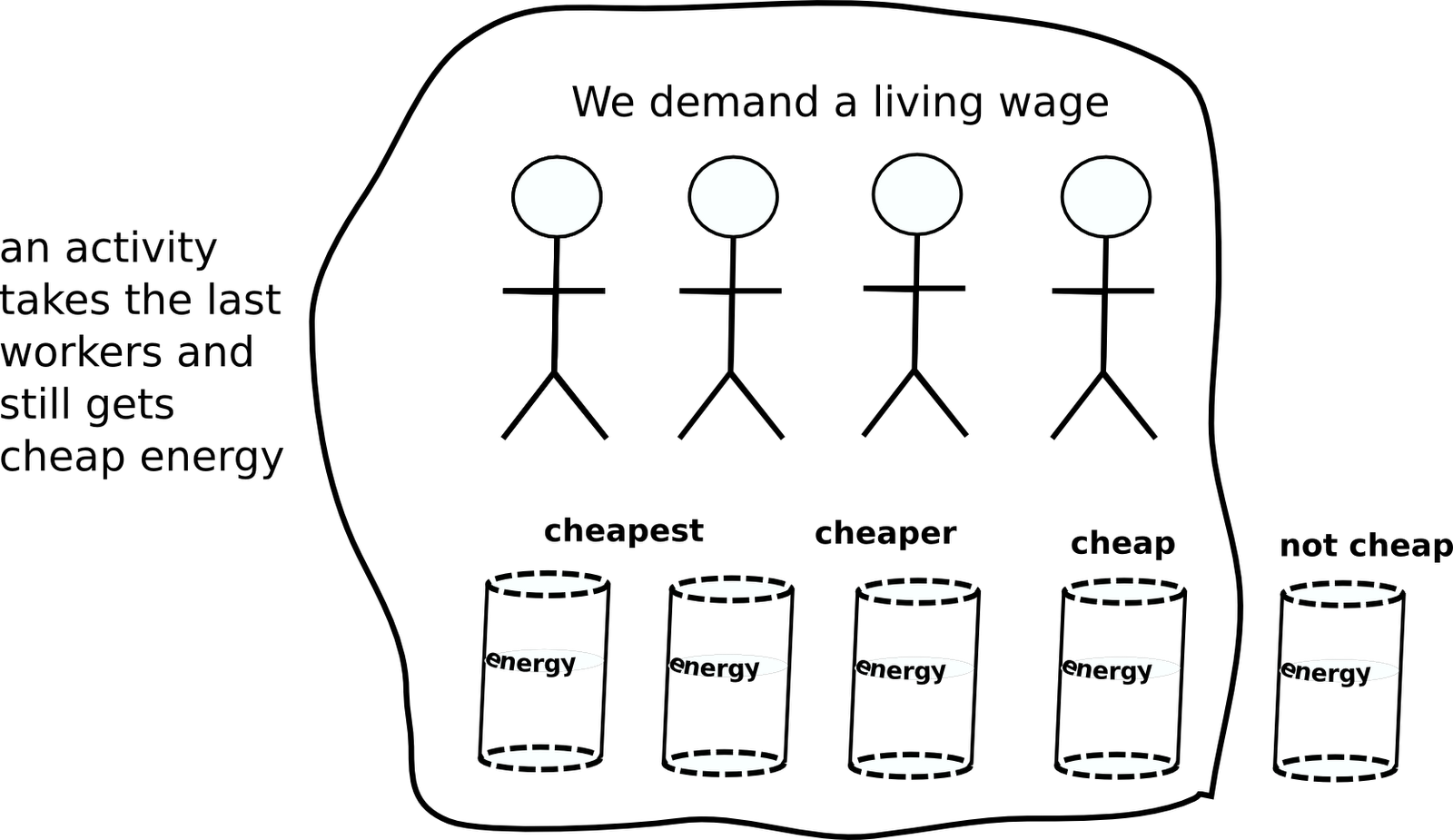


Because there was plenty of energy, energy prices were driven way down. The fact that energy prices got off the floor over the last few years shows that we aren't in this position any more.

If we get to the point where there is a significant shortage of energy then we might go back to the way things were before the Industrial Revolution, with wages driven to the floor:
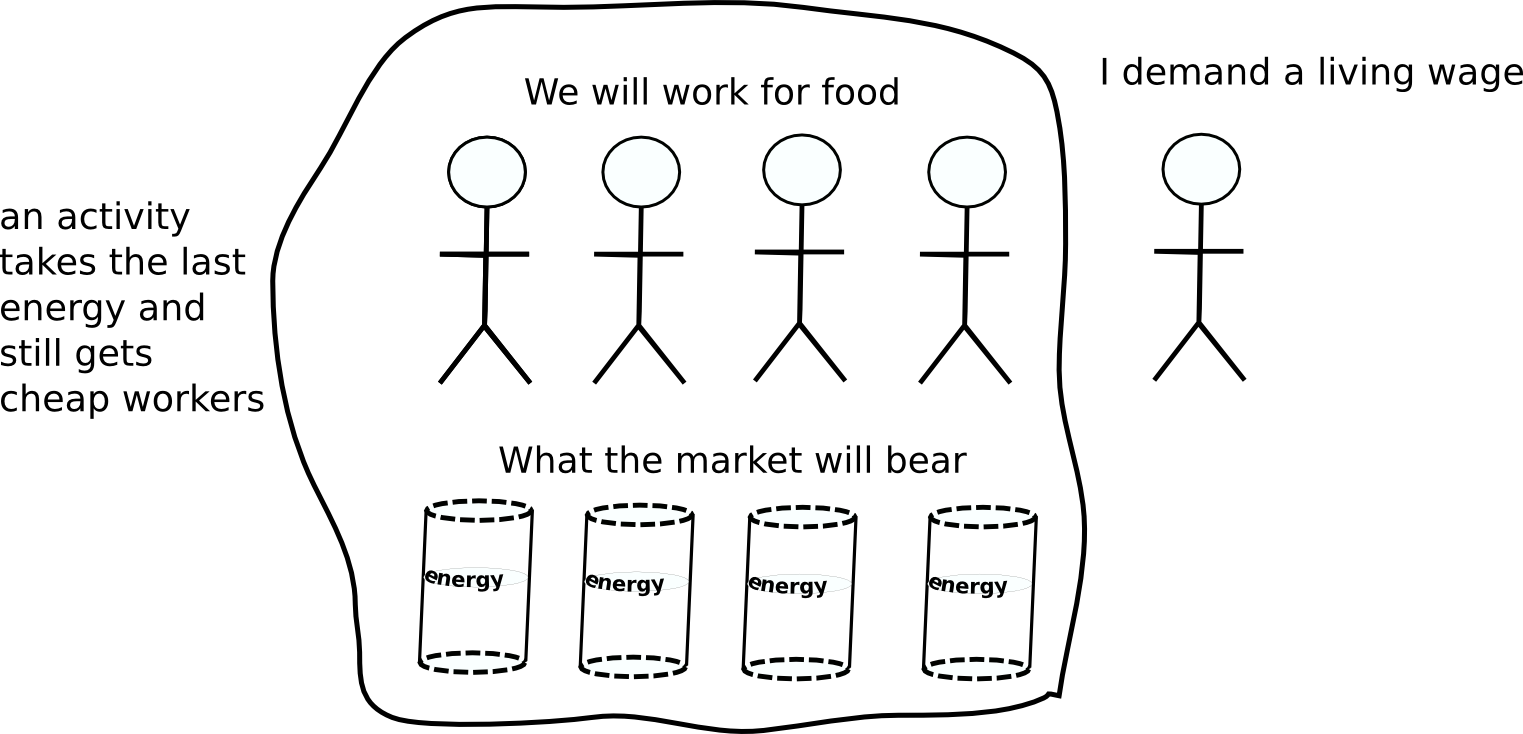

This future destruction of the middle class is an additional reason that the middle class needs to wake up politically now. With this sobering possibility in the distance, we will turn to the consideration of what needs to be done.

Navigating to a solution

There are no easy answers. That's why we must look at the process, not just grasp at possible solutions.

The Truth will set us free (or at least give us a chance)

There is this idea that the economic issue is lack of confidence. This is demonstrated in Australia by both sides of politics accusing the other of not talking up the economy. Nothing is more destructive of confidence than lies. Nothing would do more for confidence than publicly identifying the real underlying issue, explaining what is the best we can expect under the circumstances, having a plan to get that best possible result. People will get behind that, if the plan clearly identifies how it shares the pain as evenly as possible.

We don't only need more truth from government to people. We need more information available about what people and organizations are doing. We need more transparency.

The more transparency there is, then the better decisions the markets and governments will take. This becomes much more important in a long period of decline. People are going to be asked and required to make sacrifices. They need to be able to see that everyone else is also making sacrifices.

Since we need to make massive infrastructure changes at a time of economic weakness, we can't afford to make mistakes about this. We can't have politicians picking the most articulate advocate, or the most politically advantageous option. We need independent scientific and engineering teams with strong mathematical skills to conduct an open and vigorous evaluation of the costs and benefits of different options. This has to include substantial powers to investigate the claims of companies with a commercial interest in government decisions. A nice name for this investigation team might be "The Ministry of Truth": reminding us of the novel "1984" and the destructive power of spin.

“Prepare for the future” mode

People are clearly showing that they want to save to prepare for a difficult future. Meanwhile governments want their citizens to get back to normal spending patterns to get the economy back to business as usual. The people are right. We must go into “prepare for the future” mode. But governments can't prepare for the future by saving money, except by the beggar-my-neighbour tactic of saving some other safe currency, and indeed there is no such currency.
To prepare for the future we have to stop spending money on swimming pools, SUVs, eating out, etc. Instead the community as a whole has to spend on new infrastructure for a changed future.

To encourage people to save, and to channel those saving where they are needed it seems that we can learn from war time experience, and issue “Energy Crisis Bonds”. These would logically safeguard the value of the investment in real terms, as a proportion of the nation's wealth. During the period of deflation there will also be money available from unfunded spending (printed money) and that will also be available for building infrastructure -- preferably with the consent and oversite of the legislature.

Clearly switching the working population to different activities is going to cause a lot of dislocation, with massive unemployment having to be absorbed into infrastructure construction. The government will naturally make more labour-intensive infrastructure development choices, because of the substantial cost in unemployment benefits that is already effectively committed for each worker.

Happiness

Research, and common experience, tell us that people will not be less happy when they are poorer, as long as they feel that it is unavoidable, and as long as they feel that everyone is suffering equally. This can not plausibly be achieved without a higher level of transparency into individual wealth than we have known recently. We remember Mrs Bennett in "Pride and Prejudice" saying that Mr Bingley, who she hasn't met, has "five thousand pounds a year". We don't need to get back to that level, but we do need to have real statistical information published regularly about how different groups in society are faring, about asset price changes, and so on. Social harmony will be preserved if government responds quickly when some groups are benefitting unfairly from the difficulties of society as a whole.

Phases of the Energy Crisis

The first phase of the energy crisis is peak oil, and that is happening now. Oil will still be our major transport fuel for a decade and have continuing use long after that. However the steady decline in maximum achievable oil production puts a cap on maximum economic production. When we are near that cap the price of oil will limit demand and initiate further economic collapse. During this phase we are not short of energy, just of liquid fuel, particularly hitting transport. During this phase it is possible to make progress without improving efficiency, as long as liquid fuel use is reduced. For example trams use much less energy than electric trolley busses, but electric trolley bus systems are cheaper and easier to install. Looking at longer routes, trains are much more energy efficient than buses, but it is much easier to set up a bus infrastructure with natural gas powered buses. But choosing the less efficient quick solution should always be done with eyes open, and with a plan to move beyond that choice.
The second phase of the energy crisis will be the decline of natural gas. This will not hit the world uniformly since natural gas is less likely to be transported. The infrastructure for transporting gas is being built, but will not be adequate for a fully global gas market for a long time: so most places without gas will be forced to go to phase 3 early. Natural gas does make a useful replacement as a transport fuel, even though the handling issues are more difficult and potentially dangerous.
The third phase is the decline in coal which will start within 10 or 20 years. We are used to hearing that coal will last for hundreds of years. However already we see that the good quality coal and the easily accessible coal is disappearing. While there is a lot of coal out there, it is not much use if it takes nearly as much energy to get it out and prepare it for use as you get out of it by burning it. The UK provides an example of what we might see with coal production: estimates of coal reserves in the UK were still being given as decades, until just before the coal industry collapsed in the 80s. We also hope to close down coal mining earlier than necessary in order to leave as much coal in the ground as possible, to reduce the level of global warming.
Peak coal is the most important. If we aren't well on the way to non-fossil energy sources by then, the consequences will be drastic. The timing of peak coal is very uncertain. There are other important reasons to want to leave coal in the ground. So moving to carbon-free electricity generation must be given very high priority, nearly as great as the priority we give to dodging the bullet of peak oil by moving to transport options that don't depend on oil derived fuel.
The key thing to understand about phase 3 is that electricity is nice for some things, but it isn't convenient for all things. A lot of energy conversions will have to be done, a lot of batteries will have to be built. You can't just add the current electric energy and the current oil and gas energy use and say "that is how much electric energy we will need". Instead we will need much more than that, just to stay in the same place. This at a time when it is hard to get any sort of power station built at all. Governments are going to have to ride roughshod over local objections to every sort of power station.

Specific Actions

This section is meant to give an idea of the range of possible specific actions to address the Energy Crisis. Different ones harm or help different groups of people. So getting the right plan adopted and implemented expeditiously will require a lot of political energy. The problems will start with the evaluation of options and that needs to be done vigorously and transparently by engineers not politicians. However it is reasonable to expect that many actions can be identified as no-brainers that we can start on immediately. For others we can start on preliminary planning and initial work, without definitely committing to that action.

Transport

If all countries put a huge effort to move away from oil dependence for transport, it won't come soon enough to prevent real problems the next time the world economy gets going again. But the sad fact is that some will make less effort, and oil exporting nations may make no effort at all. So the countries that do make preparations need to do even more:
  • Stockpile oil while its relatively cheap during economic down periods, to release when the price shoots up;
    • Strategic Petroleum Reserves need to be much larger than they currently are. Australia currently has the worst.
  • Convert as much public transport as possible to electricity or natural gas (if locally available), and where that is not possible, stockpile the fuel;
    • Busses and trucks can all be Natural Gas in Australia.
  • Expand public transport, and rail and coastal shipping freight, as rapidly as possible;
    • Now is a good time to buy ships;
    • Busses should have more right of way;
    • Car congestion taxes should be used to keep the roads unclogged;
  • Install the infrastructure to support electric and natural gas vehicles and keep raising taxes on petrol and diesel and on new petrol and diesel vehicles;
  • Remove the duty and quickly fix any unnecessary standards issues to allow the import of electric and natural gas vehicles;
  • Install additional electric generating capacity to cover additional transport requirements;
  • Rezone land near railway stations for medium and high density housing and facilitate actual construction;
  • and lots of other stuff...

Energy

In the short run we need more energy, in order to support transport in various ways, heating, etc. The government needs to lead because, from a business point of view, there is less need for energy during the economic slump. Also alternative and nuclear energy have large up front costs which will be very hard for businesses to raise in the current credit squeeze.
  • Expand existing fossil fuel power stations where possible, to bridge the time gap to non carbon power;
  • Start to plan and build every sort of new power production, combining learning with doing: wind, geothermal, solar, nuclear;
  • Improve the electricity grid substantially in capacity and intelligence;
    • Need high capacity DC links from energy sources (like wind on west Tasmania) to customers;
    • Need to handle variable input better (like wind and solar);
    • Need to allow entepreneurs to safely connect and get reward from electricity generation and storage;
  • Provide government funded oil (and gas) exploration and development while oil prices are low;
  • and lots of other stuff...

Long Crisis Socialism

When there is a real crisis then everyone is a bit of a Crisis Socialist. Wars and economic collapses cause all governments to engage in the sort of economic activities that normally only Socialist governments do. Even George Bush is a bit of a Crisis Socialist: his administration has purchased the insurer AIG and some banks.
Normally it doesn't make sense to describe yourself as a Crisis Socialist since it is only applies in temporary circumstances. This time it's different. The Energy Crisis is going to be a very long crisis, lasting decades, with other environmental and resource limitation issues threatening to extend the crisis. The current financial crisis is the first phase. Ad hoc crisis socialism is happening everywhere, without any understanding of the nature of the crisis. We need to do Crisis Socialism properly: understand the problem, work out what needs to be done, and plan so that things are done in the right order. When we get past the crisis we can denationalize the socialized activities.
Socialism only works when people are in the mood to sacrifice for the good of the community. It works in crises. Preserving the people's good will and support is the essential ongoing requirement. This can only be done with a high level of trustworthy transparency.

Politics

‘what is democracy but the stage immediately preceding oligarchy?’ Aristotle
In the World's current circumstances Socialism is not extremism, it is just an inevitable practical step. There will be plenty of extremist voices in the months and years to come. To resist those calls we urgently need clear headed leadership that can sell the necessary sacrifice to the people.

Monday, November 3, 2008

Dealing with Deflation


Dealing with Deflation


The prices of houses and other fixed assets are declining. The prices of commodities are falling. This is deflation. It hasn't made its way to the supermarket shelves yet, so official CPI figures are still registering inflation. That's a good reason why governments need to change their way of identifying inflation.

The combination of economic decline with deflation is disastrous for many reasons. With total output declining, wages need to go down in real terms. Deflation means that wages are rising in real terms, and this can be very hard to renegotiate. The result is rapidly rising unemployment and companies going broke. Another problem is that companies are unwilling to sell assets preferring to leave them on the balance sheet at an inflated price, thus concealing the loss.

When we have a forced economic decline, and we need to get used to that, then we would like to have that run smoothly, with everyone getting poorer together. Deflation prevents that, causing the economy to seize up. Deflation is actually easy to fix, but the important thing is to do it in a way that addresses the underlying problems rather than the symptoms. More on that later.

Decline leads to Deflation

Deflation occurs when there is less money chasing the available goods and services. Since the available goods and services are going down, it is not obvious why an economic decline leads to deflation. The reason is that money is not just the stuff the central bank prints. For practical purposes it includes credit.

In an expanding economy it is relatively easy to use borrowed money to do things which will bring in more money, or for the consumer to buy now expecting to earn money in the future to repay. In a declining economy, and particularly when switching from expanding to declining, we see that loans go bad, wiping out credit, and then lenders are unwilling to lend and borrowers are often unable to roll over their debt.

There's a chicken and egg problem here. To a large extent it is the deflation itself that stops lending, which in turn leads to more deflation. Only the first few percent of the current decline was caused by the contracting oil supply.

Why does deflation stop lending? I remember when I had a young family I bought a house on borrowed money. Then, after a bout of inflation, I was lucky to be able to repay it with much less valuable money. Deflation has the reverse effect. If you borrow money then you have to repay a larger amount in real terms. If you are trying to run an enterprise and you borrow money to buy the inputs, by the time you have a finished product to sell its price has gone down. Inflation hits those lucky enough to have money in the bank, but deflation hits the most vulnerable and the most productive.

Inflation makes real interest lower than nominal interest rates. Deflation has the reverse effect, making real interest rates higher than nominal.  This is a problem for central banks, which try to stimulate the economy by reducing nominal interest rates, and they can't reduce nominal rates below zero.

Printing money

Deflation is easy to deal with. Just print enough money. It is hard to do this without distorting the economy. Even when you do want to distort the economy in a particular direction, it is a mistake to go too far, and most of the created money needs to be distributed in a way that does minimal distortion. More on that in the next section.

The next problem with printing money is that the extra money will tend to cause inflation as soon as the economy bottoms out and credit starts to rise again. So money needs to be put into the economy in a way that is substantially reversible. However it would be a good idea, particularly in our expected peak oil economic decline, to not allow the huge credit expansions of the past. This is what many advocates of sound money desire, but they want to get there by allowing deflation to run its course, and that would be a catastrophic and unnecessary mistake.

When governments print money they do it as a loan from a magic account, which then goes negative, to the spending agency. Repayments to the magic account represent money being "burnt", the reverse of "printed". It is important to understand that this is not a real loan in any sense. It is not "this generation spending money that furure generations will have to repay" or anything like that. Printing money is all about the here and now, and not about the future. It is a tax on people holding money and on lenders. It is the easiest tax to collect, which is why it is so popular in war time.

An alternative way for governments to raise money is to really borrow money, by selling bonds. This doesn't normally counteract deflation. However when people are just holding on to money, then that is deflationary and government can counteract that by selling ultra-safe bonds to soak up that money, then spending it. America particularly needs to do this because they buy a lot of oil and other stuff without sending equivalent amounts of goods and services in return. They should try to stop doing that, but until then they need to provide somewhere for all those dollars to go. Since the oil exporters and other savers have lost confidence in commercial opportunities it is necessary for the US Treasury to borrow that money so that it has somewhere to go, so that the wheels of commerce don't grind to a halt.  The $700 billion expansion of US borrowing won't be enough. Now borrowing money like that really is a debt that future Americans will repay. However Americans worry unduly about this since they can obviously print money to repay the loan if necessary. This is not an option for most countries whose loans are denominated in a foreign currency, normally US dollars. Argentina might go broke and default, but the USA never needs to.

How to spend printed money

As with inflation, preventing deflation needs to be a central bank job, not a government job. Since the solution is to print money and spend it, the politicians would spend it on vote buying and that would distort and destroy the economy.

It is also wrong to do what we are seeing worldwide: Giving money to banks and encouraging them to lend it. This is an unjustified gift to bank shareholders and bondholders, and success would be just another credit bubble.

Deflation happens when people are sensibly battening down the hatches and preparing for the future. The government has to respond to this by shifting economic activity to things that will be useful in the expected difficult economic future. The matter needs to be given careful consideration and modelling. However to me the likely best answer seems obvious:

The central bank should counter deflation by printing money and spending that money to buy and store durable commodities. This has multiple positive effects:
  • It puts money into the economy to counteract the shortage of money caused by the collapse of credit;
  • It keeps up the price of those commodities and hence the products that are derived from them, counteracting the decline of prices;
  • It can be done in a fairly automatic way, with purchases being done to preserve normal relative levels of production uniformly across all durable commodities;
  • When the economy turns and there is a need to soak up that extra money put into the economy before it causes inflation, then all that needs to be done is to sell the commodities. This is doubly anti-inflationary since it soaks up the money and reduces the price of the commodity.
  • Stockpiling useful commodities really is a good way to prepare for various future difficulties such as wars and natural disasters interfering with supply.

Critics won't mind this when the commodity is produced locally. However it is important to cover the range of commodities evenly so that the central bank can do it in a very automatic way, just like setting the interest rate. In may ways it is even more important to stockpile essential stuff that can't be sourced locally.

When the central bank prints money and buys commodities that are sourced overseas then the local currency has to be converted into the sellers currency. This takes place in the currency market. The effect is to reduce the value of the local currency relative to others. This makes exports more competitive and imports more expensive. The import of the purchased commodities has to be matched by higher net exports (and/or higher foreign investment). Either way the money that seems to be spent on foreign stuff actually finances an equivalent amount of local activity.

Summary

Central banks need to have the job of fighting deflation as well as inflation. To do this they need to print money and pump it into the economy in a reversible way so that it can be removed when inflation reappears. A simple an automatic possibility will be to use printed money to buy and stockpile (and later sell) durable commodities in their normal ratio of use.


Monday, July 7, 2008

Garnaut and the Peak Oil Tsunami

Garnaut and the Peak Oil Tsunami

Describing Peak Oil as a tsunami is actually a good analogy that goes beyond the scale and destructive power, here's why: In a tsunami an earthquake under water rapidly displaces water. But it can't spread the displacement of water across the whole ocean, so it does a larger local displacement. Then that raised water collapses spreading a wave of high water rolling outwards, followed by a trough, and so on. These waves constitute the tsunami. In the case of oil production we find that supply is unable to grow, being near its peak, while demand is increasing, so the gap at any given price keeps rising. If this gap had arisen slowly then the whole economy would slowly adapt. However it has arisen rapidly. So the price of oil has had to overshoot, rising enough to kill off the sort of demands, like vacation driving, that can easily be foregone. Meanwhile many businesses are continuing that are not viable at this oil price. They are just continuing on momentum and hope and existing contracts, and continuing to consume oil. What then happens, as we see throughout the world economy, is that those businesses die or contract. And since the oil price rise has overshot, this demand destruction will soon cause the price of oil to start falling. This will in turn overshot in a downward direction, resuscitating demand. This will then interact with the worsening supply problem to cause a new bout of demand destruction. So we see that the destruction of demand, that is necessary to bring demand into line with the long term decline in supply, will occur in waves. Each wave first hits the most easily destroyed demand, but reaches out to touch the whole economy.


If, as many have speculated, the recent increases in energy prices are already enough for us to meet our carbon emission targets, then there will be more emission certificates issued than are actually needed to meet our targets. So the market price of emission certificates will rapidly fall to zero, and there won't be any additional burden on the public. The Garnaut scheme is sufficiently flexible that we don't have to worry about whether it might be unnecessary. We must, however, look more deeply into the question of how peak oil and its related problems interact with carbon mitigation.


Some of the people who predicted the timing of Peak Oil so exactly, starting with M. King Hubbert in 1956, have also looked at natural gas and coal. Their deduction is that there is much less than is commonly supposed. The people who said until recently that there was no chance of an oil shortage, are the same people who say that natural gas and coal will last a very long time. Some of those who have been proved right on oil, believe that we will see the world peak of natural gas in 10 years and the peak of coal production in 25 years. Even the lowest scenario for carbon emissions in the IPCC report will never materialize, so the world temperature rise won't exceed 2 degrees (barring unmodelled positive feedbacks). It would however be nice if we could make the temperature rise even less.


The whole thrust of the Garnaut report is on reducing the rate of emissions worldwide to be aligned with the ability of nature to absorb that carbon. We can now see that that isn't going to be a problem. From a point of view of reducing the impact of carbon emissions the issue moves to this: As we move inevitably to a post fossil fuel era, can we leave some carbon in the ground? Clearly if, as I am convinced, those predictions are correct about peak natural gas and peak coal, then the world needs to move very rapidly to a post carbon economy. If we sensibly leave a bit of margin for error in that change, by moving more quickly than is entirely necessary, then we will, as a consequence, leave some carbon in the ground and suffer less climate change.


Garnaut encourages Australia to take the lead in mitigating climate change, since the modelling suggests that we will be the worst sufferers. Other countries are less negative about warming. Russians are publicly licking their lips. The Canadians are too polite. Many countries are too poor to consider any sacrifices. Garnaut himself has expressed pessimism about the whole enterprise. But the world has to respond to peak fossil fuel to lead us to a post carbon energy environment. If we do that as fast as we possibly can then we're still more likely to be late than early. If we're early and manage to leave some carbon in the ground that will be a bonus. If you're worried about climate change but don't actually believe that fossil fuel will peak, I'd still urge support for a world wide campaign to address peak fossil fuel, because that is more likely to actually move the world off carbon than appealing to moral sentiments and good will.


The aims of climate mitigation and overcoming peak fossil fuel are better aligned than they seem to be. Let's look at the two most obvious conflicting cases.

  • Oil is running out first. It is the world's main transport fuel. Compressed or liquefied natural gas is a good replacement. In the circumstances it is a bad idea to burn natural gas for electricity instead of coal. As Matt Simmons says in a recent presentation "Natural gas is our most precious fossil fuel". Carbon trading (or tax) oriented to reducing the rate of emissions may force a switch to gas. However if, as indicated, the gas will soon peak, then we will get back to burning the coal later. If you see the aim as leaving carbon in the ground then the advantage of switching to gas to generate electricity is much less, if any.
  • There is a huge worldwide infrastructure for liquid fuels for transport: most particularly the existing vehicles and service stations. We can't magically switch all that to natural gas and electric in a short time frame. One way to preserve the value of that infrastructure and reduce the economic impact of peak oil is, during the transition, to do some conversion of gas to liquid (GTL) and coal to liquid (CTL). This requires energy, so the quoted figures show high carbon emissions for this process. This is exaggerated however, because the energy source doesn't have to be a fossil fuel one. One needs to also consider the cost in energy of moving the infrastructure away from liquid fuels more quickly, if we don't do GTL/CTL.
Garnaut is an economist and assumes, I guess, that the magic of the market will produce a replacement energy source. It will be wise to be more proactive and to move forward with an option we know will work, even if that doesn't end up being the economic winner. Many people are hoping for coal combined with carbon capture and storage (CCS). That is not going to work if CCS fails or if the world runs out of coal, and I expect both of those things to happen. It is hard for renewables to fill the whole bill because they are intermittent and their huge scale inevitably involves significant ecological impact. I have high hopes for geothermal, but the limitations and costs of drilling technology suggest that this won't be universally applicable.


To me it is clear that the core energy infrastructure for most of the 21st century will have to be nuclear power. If it is inevitable, then let us get there as soon as possible and leave some carbon in the ground. There are many wild claims about this. Some say it is not price competitive. In that case it won't happen, and a lot of dispute will be unnecessary. With modern reactors the available uranium and thorium will last a long time, and there need not be a problem of very long term waste. Nor are modern reactors useful for making real atomic bombs. It would also be possible to site nuclear reactors in safe places and generate other fuel in various ways: e.g. hydrogen from water. Australia would be such a safe place, geologically and politically.


The question of whether Nuclear Power is necessary or not is one of fact. There are many other important questions that need to be answered. We need to get past politicians believing the most plausible experts and pandering to voters special interests. We need open vigorous expert well funded impartial investigations of the facts by people with mathematical skill. As Professor David MacKay says: we need numbers not adjectives, modelling not arm-waving. Prof MacKay is head of the Inference group in the Physics Department at Cambridge. I urge everyone to read his book on sustainable energy which is available free on the Internet at withouthotair.com.


We are running out of fossil fuel. This is the immediate problem that we need to address. Luckily doing so will address climate change more effectively than worldwide cooperation and goodwill were ever likely to do.

Sunday, June 22, 2008

ECAL posting

The previous post is from a google doc: http://docs.google.com/Doc?id=dg7nkx7d_41g5zrpx8k. I don't know why it decided to make H3 headings bigger and brighter than H2.

I'm looking for people who roughly agree on proposed policy. to discuss the possibility of forming such an organization. Mostly in Australia, but if people want to do the same elsewhere it would be a good idea to have an umbrella organization.

If you're interested in joining, please comment in this post. If you want to disagree on my policy items please comment on the previous post.

Energy Crisis Action Lobby

Energy Crisis Action Lobby

Political response to the Energy Crisis is misguided. This is a matter that affects everyone. The Energy Crisis Action Lobby (ECAL) is an organization of like minded citizens to press for a recognition of the seriousness of the crisis, and to urge the rapid implementation of valuable policies. ECAL's membership consists of citizens that support 3 specific policies:
  • Continuous vigorous well funded open investigation of all relevant facts, led by mathematically expert scientists and engineers.
  • Actions to address the Energy Crisis will incidentally address climate change, but additional actions to address climate change can not be sustained during the crisis.
  • Nuclear energy is the essential core energy source for a world without fossil fuel.
Many other specific policies and actions are needed, and ECAL will participate in the debate about the possibilities. These need to be subject to vigorous and continuous assessment. We can't afford too many more mistakes (such as using ethanol from agricultural land for transport fuel). A forth principle is implicit in the educational aims of ECAL: Voters need to be fully informed and made aware of the inevitable sacrifices. ECAL has complete confidence in the willingness of the people to work together to solve this crucial national and world wide crisis, as long as they are fully informed and confident that the sacrifices will be shared.

Characterization of the crisis

There is a limited supply of fossil fuel and it is now running out. Currently oil producers are unable to expand supply and supply will decline very soon if not now. Peak natural gas will follow within 10 years and peak coal within 25. Demand would be expanding rapidly now if prices had stayed low. The price has to rise high enough to destroy that incipient demand and more, to make supply and actual demand balance. This demand destruction will reduce the output of the world economy. This is not like previous economic contractions which were part of a cyclic financial process. As such it will continue, and continue to worsen, until we rebuild the economy with new infrastructure based on new energy sources. So the rise in the price of oil is not caused by a bubble, or by speculators. It can't be fixed by government action, other than moving to different energy sources. It isn't likely that there will be a complete collapse of civilization as some predict, but if that were to happen then it is impossible to see how industrial civilization could ever get going again without the surface coal and oil oozing out of the ground that fueled the initial rise to our current industrial state. Our failure to heed many warnings, starting with M. King Hubbert in 1956, means that we have no chance of escaping a serious economic contraction which will likely far exceed that of the Great Depression. Managing that contraction fairly and optimally, so that we can emerge from the other side without collapse, is the business of all governments over the next 40 years. Business as usual (BAU) is over. Keeping the voters uninformed to prevent panic is highly counter-productive. We need debate, we need open investigation and analysis, and we need action, but all action needs to be kept under review so that the inevitable mistakes (such as biofuel from food) are not continued.

Intensive open investigation of technical issues

There are many important technical debates which will shape the way we respond to the energy crisis: How quickly will oil exports disappear? How will that affect the availability of other things like fertilizer? How will the economy respond to shocks? Will algal biodiesel save the day? How long will natural gas last? Should we go through a phase of compressed natural gas vehicles, or go straight to electric? And many more. Currently these debates get carried on in an academic style where people express a detailed opinion, but rarely respond to those with a different point of view. Also a lot of important information is hidden as trade secrets. It is crucial that planning be put on a less haphazard footing. We need mathematically competent experts to conduct open enquiries on these and other important matters. They need to be able to bring opposing parties together to find the core of their disagreement. They need to be able to extract important information where necessary. They need to be able to fund research to shed light on crucial technical questions. These investigations need to be conducted by mathematicians, or by scientists and engineers with strong mathematical skills and insight. As Prof David MacKay, head of the Inference group in the Physics department at the University of Cambridge has said, we need numbers not adjectives, modelling not arm-waving.

Global Warming action is not a short term priority

There are 4 reasons why economic action to address global warming is not appropriate now:
  • The amount of fossil fuel that can be economically extracted and consumed is much less than feared in the IPCC and other reports. Even the lowest option considered by the IPCC is more than will ever be burnt.
  • We have already had the price rises for fossil fuel needed to foster efficiency and alternatives. And indeed even higher rises are coming. There is no need for specific carbon taxes as well.
  • Government action to address the Energy Crisis will also mostly addresses CO2 emissions, and it will do so with much greater universality and urgency than would ever have happened to prevent the less immediate and less desperate issue of climate change
  • This mega oil shock is going to cause immense economic pain throughout the world. Until that is reversed there is no chance that governments will impose extra pain to address global warming.
Of course scientific understanding of the climate still needs to be strongly supported.

Nuclear Energy is a crucial part of the global solution

While we have high hopes for renewable energy, particularly geothermal and solar-thermal, still their scalable effective operation remains to be seen. Corn-based biofuel has been the first major renewable to be brought on stream. With high use of mechanized equipment and fertilizer it doesn't produce significant (or perhaps any) net energy. We can't afford to waste too much effort on such mistakes. There are plenty of potential issues with each of the other renewable energy sources. We mustn't step off the cliff into a world without fossil fuel without initially having substantial nuclear energy up and running. Modern nuclear energy is very reliable and fails safe. By moving to breeder reactors and utilizing Thorium as well as Uranium it is possible to make the existing mineable resources last a long time and not produce long-lived waste. Australia, with lots of sunshine and geothermal potential, might survive on renewables. However we will be a major supplier of nuclear fuel, we need the world to get its nuclear act together, and we have a particular reason to want the world to switch to the safer thorium since we are likely to be the major exporter of that. So we have good reason to get experience building and running modern nuclear reactors. Maybe voters will not allow these near population centres. However if the economy goes as bad as expected, then communities will be pleased to have the work and other industry that comes with them. Prof David MacKay, head of the Inference group in the Physics department at the University of Cambridge, is writing a book on sustainable energy, based on his principle of "numbers not adjectives". When he first started his investigation he was anti-nuclear. However he discovered that Britain can not be supplied with energy without incorporating a significant nuclear component.

Possible Actions

There are a lot of practical actions that can be taken to reduce the impact of the energy crisis, and to try to overcome it. Many have an energy cost and we must choose wisely which to support. The following list is illustrative, not exhaustive:
  • Lower speed limits and run an education campaign on saving petrol when driving.
  • Build infrastructure for Compressed Natural Gas vehicles, and/or electric vehicles.
  • Stop putting money (and energy) into road building.
  • Enhance rail: new routes, new rolling stock, electrification.
  • More CNG buses with more bus lanes and other right of way.
  • Shipping: LNG fuel? Docks integrated with rail as well as trucks.
  • More support of energy and transport research.
  • Build big parking stations near railway stations.
  • Make suburban trains more freight friendly.
  • Forcibly rezone land near railway stations for high density.
  • Stop plans to burn natural gas for electricity, since it can replace petrol/diesel for transport, so we mustn't waste it.
  • Develop, with the help of India and the US, a plan for nuclear energy. Implement it.
  • Help India to get to a nuclear future based mostly on Thorium. Partner with them and with the US to provide this to the world, using our large Thorium deposits as the fuel source.
  • Build large solar thermal and geothermal power stations so that we can evaluate their potential for large scale reliable energy.
  • Keep using low quality coal for power generation (since we can't afford to switch to gas), and exporting the better stuff. We also need to export natural gas to the world, which will be hit much harder by the Energy Crisis than we will. We need to keep enough to complete our transition to a post carbon world.
  • Build gas to liquid and coal to liquid capability, to extend the useful life of the massive infrastructure supporting liquid transport fuel.
  • ...
There is no shortage of things to do. With the money from our net energy exports we should be able to keep employment high through the crisis. We should take advantage of worse conditions in other English speaking countries to bring in people with useful skills and expertise. Because Australia is a net energy exporter our position is far better than most. However we are unprepared for peak oil which is happening now, and we are an oil importer. Also the greater collapse of our trading partners will harm us. Increased international transport costs will also be a problem because of our remoteness.

Additional Notes

Building the nuclear future

Currently nuclear power plants are one-off constructions designed then run by highly qualified staff. This will make it hard to expand nuclear energy rapidly enough to replace declines in fossil fuels. This can be overcome by building smaller nuclear plants which are identical and mass produced to exact specifications and which run automatically in a fail safe way. There are many groups working on this and there are no overwhelming technical issues. The most viable designs use thorium and cannot be subverted for military use without the sort of time consuming effort that would raise alarm bells and be easily circumvented.

Climate Change issues

Here are some things that the people worried about climate change will argue for:
  • No GTL/CTL. Response: The quoted values for CO2 emissions are exagerated. You need energy to do the conversion, but that energy can come from nuclear/renewable sources.
  • Replace coal with gas for electricity. This wastes the fluid advantage of gas which makes it suitable for piping and for transport. We can't afford to do that.

Energy conversion issues

Nuclear and renewable energy will mostly be in the form of electricity and heat. This has to be converted to be useful for transport. Batteries convert electricity to chemical energy. Or we can use energy to create fluid fuels. For example you can use energy to get hydrogen from water, then burn it later to get the energy. There are lots of choices, but the common fact is that you need a lot more energy than at present because a lot of energy is used in the conversions.

Investigation details

The need for nuclear and the lesser importance of climate change action are based on a particular view of the facts. These facts would also be up for investigation by the proposed continuous open investigation. The key characteristic of the investigation teams, in addition to their ability to understand mathematical aspects of scientific work, will be a willingness to change their mind and admit to having been wrong when their are new facts or improved modelling of other analysis of the situation. This will be improved by minimizing the extent to which they reveal their own opinions during the investigation, or identifying themselves in conclusion documents.

Managing economic decline fairly

It is a human characteristic to take risks to avoid a loss, even a small loss. The farmer risks injury to stop people stealing apples from his tree. This might be irrational on a single occasion, but it is necessary on a long term basis. On the other side of the coin people are happy to make sacrifices in a common cause when they feel that others are doing the same. So it is essential that the coming economic decline be managed by tapping into that latter characteristic. Otherwise we'll get violent protest, as we have started to see already. The way to achieve this is with a high level of transparency. Currently remuneration is private. This has allowed the high level managers to capture most of the extra income during the recent boom, and lower ranks have been tolerant as long as they were making some progress, or had the opportunity to do so. This will not work during the coming decline. Resistance to ad hoc wage cuts will make it hard for businesses to survive. What is needed is government managed transparency about incomes, and coordinated cuts in incomes by all, falling more strongly on the higher ranks. These coordinated cuts might be in a single business or industry, but it might also be necessary at times to do it nation wide, to maintain the general level of employment. Higher levels of transparency are also needed to facilitate business planning during economic decline. Parts of the economy are interconnected and there needs to be coordinated planning to change the way the economy works. For example currently trucks take things from pickup to final destination. This may well change to using trains and shipping in the middle for longer movements. This can be achieved by allowing blind economic forces to take their course, but it will be better if there is some government coordination of the change, with involvement of the participants. Truck owners, small farmers and many other people needed to be helped through the crisis, even if in some cases it is just to help them see that their business is not going to continue to be viable.

Document History

v1.0 2008-06-21: initial version.

Thursday, April 17, 2008

Peak Carbon and Global Warming

I have lately been obsessed by Peak Oil and related stuff (Peak Gas, Peak Coal, etc). I've got to stop worrying about this stuff because it is time consuming and there is not much I can do about it. So here's my summary, to get it off my chest.

Huppert predicted in 1956 that US oil production would peak in 1970. He was derided but was almost exactly right. He predicted world production would peak in 2000. It is currently plateauing, only slightly late. However nobody seems to talk about a very big difference between US peaking and the world peaking. When the US peaked, it started importing, but the price wasn't much affected. When the world peaks the price goes up, potentially quite a lot, as we see. This means that a lot of things start to happen:

  1. People use less (vacation travel the first to go).
  2. Exploration goes up (though there probably aren't any more big oil fields with cheap production to find).
  3. More expensive recovery techniques can be used in existing and restarted oil fields. This includes using nuclear power to extract oil from Canada's tar sands.
  4. Gas-to-oil and coal-to-oil technology becomes profitable. [Gas-to-oil is insane with peak gas not far away, but coal to oil is bound to be important, despite the impact on CO2 production.]
  5. Substitutes come into play: electric cars, nuclear energy, renewable energy.
These things take a while. In the short term all these things are likely to be swamped by a global recession. Unfortunately that will reduce demand for all energy and prices will, temporarily, fall. This is where it is very important for government to step in and do what it can to encourage all the processes above to continue during the recession.

America will pull itself out of the recession by energetically going back to making real things and doing real things, not just shuffling money around. In particular they will drive the development of the energy industry. One only has to look at how quickly they ramped up ethanol production given a little incentive. In particular I expect them to lead the push to nuclear energy, thermal solar energy, and electric transport.

There is a vast oil-based transportation infrastructure. We can't turn it around on a dime. Oil for transport will continue to dominate for the next 15 years even though the consequences of expensive transport will be horrible:

  • A return to more locally produced and more expensive goods and food.
  • Economies that work less well, so that everyone is poorer.
  • Everything that uses oil for raw material or transport is more expensive, particularly food.
  • Much less tourism, particularly global.
  • Sea transport is favoured, then rail. Truck transport will be for shorter hauls. Much more messing around getting stuff between different media types: more use of containers/etc.
  • Much reduced jet travel, some return of propeller planes.
The pressure will be on because production of oil will not keep pace with demand, and may decline. So the price will rise inexorably, except when financial systems fail and there are periods of widespread economic collapse. There needs to be a lot more thought about how to manage periods of economic decline without revolutions, wars, starvation, etc.

Prices are already at the point where nuclear energy and solar thermal energy are competitive with coal. The demand for coal for coal-to-liquid will make it even more expensive. So we can move beyond a carbon based economy starting now. This is an unbelievably huge project. It requires us, the whole world, to put a very large fraction of our productive resources into it, at a time when our productive resources will be severely constrained by the growing cost of oil (shortage of oil). But we have to do it, because if we haven't got there when the oil/gas/coal runs out then the bootstrapping process to get back to prosperity will be very hard. It will be done because, with high energy prices, there is money to be made by doing it.

Many people think that catastrophe cannot be averted. Certainly it is hard to have faith in politicians:

  • Cheney and Bush were well aware of peak oil before elected, and their response has been Iraq and food-to-fuel.
  • Australia has just elected an anti-nuclear government.
  • Windmills and solar energy use a lot of steel.
  • Nuclear industry is limited by shortage of expertise and perhaps some essential materials and capabilities.
Still I think we will be ok on non-transport needs and we'll survive the transport problems with a bit (or a lot) of belt-tightening and localization. I'd certainly like to see economic models that confirm this with non-optimistic projections for oil production. The economic theory that increased prices must produce supply does NOT apply to a finite resource like oil. Does the Treasury know this?

Which brings us to global warming. The good news is that there is not enough carbon in the ground (that can be extracted for less energy than they produce) to cause the extreme CO2 rises sometimes considered. It can't go over 500 ppm. The bad news is that the inertia of the vast petrol/diesel transport infrastructure means that we will use more carbon and generate more CO2 than economic fundamentals require (given nuclear energy). In particular there is no way to stop a lot of coal-to-oil production. Even if Australia didn't do it, and we didn't allow our exported coal to be used for it, still our exported coal would just displace other coal that was used for it. Better if it is done as cleanly as possible in Australia.

So there can't be reductions in CO2 emissions between now and 2020. Impossible. The serious economic problems that will be faced between now and then will make extra carbon charges impossible to maintain, and also unnecessary as the natural price of carbon will be enough to encourage everyone who can get off it to do so. The government's job is to plan and to push ahead of the market. Build nuclear and renewable energy power stations, and sell them. Build railways and ship docking. Get into ship building.

Beyond 2020 there will be huge reductions. 90% by 2050 is guaranteed. We just hope the reductions will be because of a smooth and prosperous switch to nuclear and renewable energy, and not because of global economic collapse.